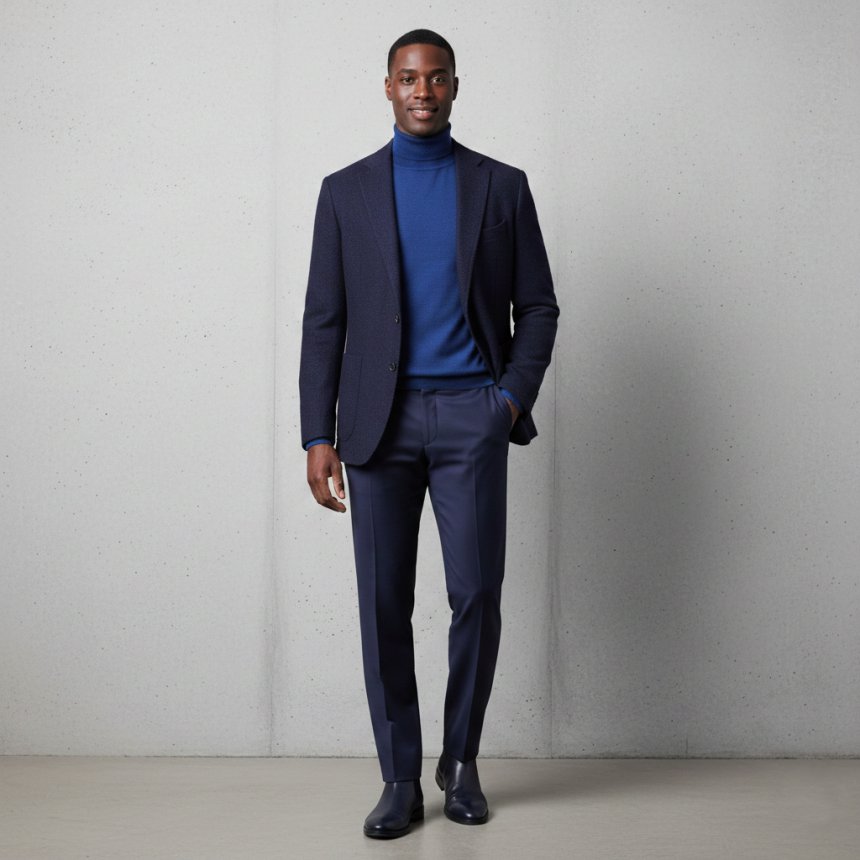
Why Dressing Well Makes You More Successful (Science-Backed)
Discover the science-backed link between dressing well and success. Learn how the Halo Effect and Enclothed Cognition boost income, confidence, and power. This is not fashion—it's your unfair advantage. Get the data-driven blueprint.


The Unfair Advantage You Can No Longer Ignore: Why Your Next Outfit is Your Most Powerful Career Weapon
Let's be brutally honest: anyone who tells you that "clothes don't matter" and that "it's what's on the inside that counts" is sabotaging your success.
It’s a comforting lie, a well-intentioned platitude that crumbles under the weight of decades of scientific evidence. The truth is far more potent and, frankly, liberating. Your appearance is not a shallow vanity project; it is a non-verbal communication system operating at the speed of light, broadcasting signals about your competence, credibility, and status long before you utter a single word.
This isn't about fashion. This is about psychological armor, social physics, and cognitive bias. It's about hacking the deeply ingrained neurological shortcuts every human brain uses to make snap judgments. Dressing well is one of the few high-leverage activities that directly influences how you are perceived and, more importantly, how you perceive yourself.
As someone who has advised Fortune 500 executives and scaling startups on the psychology of professional presence, I've seen this transformation firsthand. The data doesn't lie, and the stories are consistent. This is your definitive, science-backed guide to understanding and weaponizing this unfair advantage.
Section 1: The External Game - How the World Sees You (The Halo Effect in Action)
Your success is often determined in the first seven seconds of an interaction. This is where the brain's "cognitive shortcuts" take over, and clothing is one of its primary data points.
1.1 The Halo Effect: Your Clothing's Superpower
The Halo Effect is a well-documented cognitive bias where our overall impression of a person in one area (like their appearance) influences our perception of them in other, unrelated areas (like their intelligence or trustworthiness).
· The Science: A seminal study published in the Journal of Applied Social Psychology found that well-dressed individuals are consistently rated as more confident, successful, and financially prosperous. In a business context, this halo extends to perceptions of competence and reliability. When you look the part, people’s brains automatically assume you are the part.
· The Brutal Reality: A disheveled, ill-fitting outfit can trigger a "Reverse Halo Effect" or "Horn Effect." If your clothes are sloppy, a client or manager might unconsciously assume your work will be, too. It’s unfair, but it’s a fundamental part of human neurology. You are fighting millions of years of evolution that prized the ability to quickly assess a potential ally or threat.
1.2 The "Sartorial Stereotype" & Perceived Competence
We are all guilty of stereotyping based on clothing. This isn't about morality; it's about pattern recognition.
· The Science: Researchers from Princeton University found that people can make judgments about a person's competence in a mere 100 milliseconds based solely on their appearance. A study from the Kellogg School of Management demonstrated that "dressing for the job you want" isn't just a cliché. Participants who wore more formal business attire consistently outperformed their casually-dressed peers in negotiations and were perceived as more authoritative.
· The Practical Application: Think of your target audience. What does "competence" look like to them? For a venture capitalist, it might be a sharp, minimalist blazer that signals focus and efficiency. For a creative director, it might be a thoughtfully curated, expressive ensemble that demonstrates taste. Your goal is to align your appearance with the sartorial stereotype of success in your specific field.
1.3 The Trust Equation: How Attire Builds Instant Credibility
Trust is the currency of all successful relationships, especially in business. Your clothing is a direct deposit into your trust bank.
· The Science: A study in the Harvard Business Review highlighted that professionals who dress in a way that is perceived as "high-status" are more likely to be believed and followed. Neat, tailored, and context-appropriate clothing signals attention to detail, self-respect, and respect for the occasion and the people you're with. It tells the world, "I have my life together, and you can rely on me."
· The Human Element: When you meet a doctor in a clean, white coat, you instinctively trust their diagnosis more than if they were in a stained t-shirt. The same principle applies to you. Your "uniform" builds immediate credibility.
Section 2: The Internal Game - How Dressing Well Rewires Your OWN Brain
This is the most overlooked and personally transformative aspect. The external perception is powerful, but the internal psychological shift is where true, lasting change happens.
2.1 Enclothed Cognition: The Proven Science of How Your Clothes Shape Your Performance
Forget "dressing for success." You need to start "dressing for performance." This is where the real magic happens.
· The Science: Coined by researchers Hajo Adam and Adam D. Galinsky in the Journal of Experimental Social Psychology, "Enclothed Cognition" describes the systematic influence that clothes have on the wearer's psychological processes. In their landmark experiment, participants who wore a lab coat performed significantly better on attention-related tasks than those who did not. But here’s the critical twist: when told it was a painter's coat, the performance boost disappeared. The meaning of the clothing matters.
· What This Means For You: When you put on a "power outfit," you are not just covering your body. You are invoking the symbolic meaning of that clothing. A sharp blazer isn't just wool and thread; it's a garment associated with authority, strategy, and competence. When you wear it, you begin to embody those traits. Your focus sharpens, your posture improves, and your mindset shifts from "casual" to "capable."
2.2 The Confidence Feedback Loop
Confidence isn't something you just have; it's something you create through action. Dressing well is one of the easiest, most accessible confidence-creating actions available.
· The Process:
1. Action: You consciously choose an outfit that is sharp, fits well, and makes you feel powerful.
2. External Reaction: You receive positive non-verbal feedback—a second glance, a firmer handshake, a more attentive audience.
3. Internal Reinforcement: This external validation confirms your internal belief that you look good, which boosts your confidence.
4. Performance: This newfound confidence makes you speak more clearly, stand taller, and engage more proactively. This leads to better outcomes, which further reinforces the cycle.
· The Expert View: As I tell my clients, "You can't think your way into confident action, but you can act your way into confident thinking." Your clothing is the first and most decisive action you take each day.
2.3 The Power of Ritual and Identity
Your morning routine sets the tone for your entire day. Dressing well is a ritual that marks the transition from your private self to your public, professional self.
· The Psychology: By treating getting dressed as a deliberate ritual rather than a mundane task, you are actively constructing your professional identity. You are telling your brain, "The work day starts now. It's time to be focused, effective, and ambitious." This is a powerful form of self-signaling that primes you for high performance.
Section 3: The Tangible Returns - Dressing Well and Your Wallet
Let's move from the theoretical to the concrete. How does this "unfair advantage" translate into measurable, real-world results? The data is staggering.
3.1 The Income Correlation: Are Well-Dressed People Paid More?
Multiple studies have shown a direct, though complex, correlation between attire and earning potential.
· The Data: A comprehensive study out of the University of Chicago found that individuals who were perceived as "more competent" based on their appearance—a perception heavily influenced by clothing—were correlated with higher incomes. Furthermore, a Forbes report indicated that well-dressed individuals are not only perceived as more successful but are also more likely to be promoted into leadership positions.
· The Caveat: This isn't a simple "wear a suit, get a raise" equation. It's about the cumulative effect of the Halo Effect, increased confidence, and enhanced performance. When you consistently present yourself as a leader, you are more likely to be given leadership opportunities, which come with higher compensation.
3.2 Negotiation Power: Securing the Win Before You Even Speak
Whether you're negotiating a salary, a contract, or a project timeline, your appearance is a critical factor.
· The Evidence: The Kellogg School of Management research is clear: formal attire confers a significant advantage. Negotiators in formal wear were less emotionally reactive, more willing to make the first offer (a key tactical advantage), and ultimately secured better outcomes than their casually-dressed counterparts. Your clothing literally puts you in a more powerful strategic mindset.
3.3 The Network Effect: Opening Doors and Building Alliances
People are naturally drawn to those who appear successful and put-together. This is the "Matthew Effect" in sociology: "For to everyone who has, more will be given."
· The Reality: A polished, professional appearance makes you more approachable to high-level connections and more memorable in a sea of mediocrity. At a conference or networking event, who are you more likely to strike up a conversation with: the person in a crisp, well-fitted outfit who carries themselves with assurance, or the person in a wrinkled, ill-fitting shirt? Your attire acts as a social and professional lubricant.
Section 4: The Actionable Blueprint - How to "Dress Well" Without Breaking the Bank or Your Spirit
"Dressing well" can feel vague and intimidating. Let's demystify it. This isn't about spending a fortune; it's about deploying strategic intelligence.
4.1 The Non-Negiable Foundation: Fit is King
This is the single most important rule. A $50 shirt that fits you perfectly is infinitely more powerful than a $500 shirt that doesn't.
· What "Good Fit" Actually Means:
· Shirts/Jackets: Shoulders seams sit perfectly at your shoulder bone. The chest has enough room to button without pulling. Sleeves end at the base of your thumb.
· Trousers: No bunching at the shoes. A clean line down the leg. They should stay at your waist without a belt (the belt is an accessory, not a necessity).
· Pro Tip: Find a good tailor. It is the best investment you will ever make in your wardrobe. Off-the-rack clothing is made for a hypothetical average body; a tailor makes it for your body.
4.2 The Power of a "Uniform" and a Capsule Wardrobe
Decision fatigue is real. Every minute you spend agonizing over what to wear is mental energy drained from more important decisions.
· The Solution: Develop a personal "uniform." This doesn't mean wearing the same thing every day, but creating a core set of interchangeable, high-quality items that work together. Think Steve Jobs' turtleneck or Barack Obama's blue or gray suits. By limiting choices, you conserve willpower.
· Building Your Core:
· 2-3 Pairs of Quality Trousers (e.g., navy chino, grey wool, dark denim).
· 3-4 Well-Fitted Shirts (e.g., two white, one light blue, one subtle pattern).
· 1-2 Quality Blazers/Sport Coats (Navy is the most versatile).
· 2 Quality Knitwear (A fine-gauge merino wool sweater is a powerhouse).
· 1-2 Pairs of Excellent Shoes (Keep them polished and in good repair).
4.3 The Psychology of Color
Color is a non-verbal language. Use it strategically.
· Navy Blue: The king of professional colors. Conveys trust, stability, and authority. Ideal for interviews and client meetings.
· Black: Sophisticated, powerful, and formal. Can also be perceived as aloof or intimidating. Use it when you need to project absolute authority.
· Grey: The neutral diplomat. Conveys logic, neutrality, and calm. Excellent for collaborative settings.
· White/Crisp Blue: Projects cleanliness, honesty, and efficiency.
· Red (as an accent): A powerful signal of energy, confidence, and attention. A red tie or a red dress can be a powerful tool in moderation.
4.4 Grooming & The Finishing Touches: The Devil is in the Details
You can have a perfectly tailored suit, but if your shoes are scuffed and your hair is unkempt, you've undermined the entire effect.
· The Checklist:
· Shoes: Immaculate. Always.
· Grooming: Neat hair, trimmed nails, fresh breath.
· Accessories: A quality watch, a neat belt, a minimal portfolio. Avoid loud, distracting jewelry or accessories that clash.
Section 5: Beyond the Suit - Context is Everything
"Dressing well" is entirely dependent on your environment. The goal is to be the best-dressed version of yourself within your context.
· The Creative Industry: "Well-dressed" might mean a curated, artistic ensemble—a high-quality, interestingly cut t-shirt, a designer jacket, and fashion-forward sneakers. The principles of fit, color coordination, and intentionality remain paramount.
· The Tech Startup: The uniform is often smart casual. Here, "dressing well" means elevating the basics. Instead of a baggy company hoodie, it's a well-fitted, high-quality merino wool sweater or a structured bomber jacket with dark, clean jeans and minimalist sneakers.
· The Corporate Environment: This is where traditional rules apply most strongly. Adhere to the dress code, but aim for the top tier of it in terms of fit and quality.
Conclusion: Stop Leaving This Advantage on the Table
The science is unequivocal. Dressing well is not a superficial pursuit. It is a multifaceted psychological tool that:
1. Externally, triggers the Halo Effect, making you appear more competent, trustworthy, and successful.
2. Internally, rewires your brain through Enclothed Cognition, boosting your confidence, focus, and performance.
3. Tangibly, opens doors to higher income, better negotiation outcomes, and a stronger professional network.
This is not about vanity. It is about strategy. It is about understanding the rules of the game humanity is hardwired to play and choosing to play them skillfully.
Your next outfit is a choice. You can choose to be overlooked, underestimated, and operating at a cognitive deficit. Or, you can choose to put on your psychological armor, step into your most capable self, and claim the unfair advantage that has been waiting for you all along.
The moment you start dressing for the success you want, you have already begun to achieve it.
Share
What's Your Reaction?
 Like
0
Like
0
 Dislike
0
Dislike
0
 Love
0
Love
0
 Funny
0
Funny
0
 Angry
0
Angry
0
 Sad
0
Sad
0
 Wow
0
Wow
0