
The Burden of Performance: Why Society Values What You Provide, Not How You Feel
The burden of performance is real. Society values what you provide, not how you feel. Stop waiting for validation and reclaim your masculine worth.

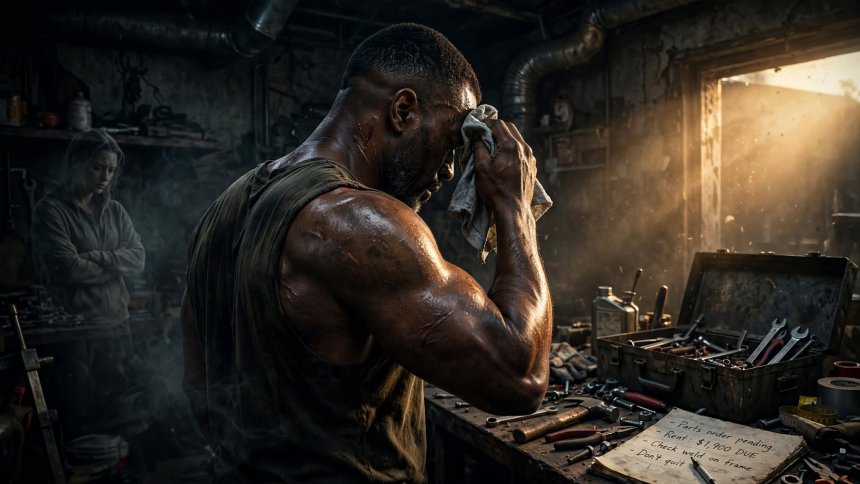
Nobody is coming to save you. And that’s the best news you’ll get all year.
I lost everything at 27.
Not in a dramatic, movie-scene kind of way. No gambling addiction. No catastrophic lawsuit. Just a slow, suffocating realization that my feelings had been running my life while the world was keeping score of my output.
My girlfriend left. Not because she was cruel—but because I was broke, unfocused, and waiting for someone to acknowledge my pain instead of building something worth respecting.
My business collapsed. Not because the market shifted—but because I was more concerned with how I felt about the work than whether the work actually delivered value.
I remember sitting in a rented room, staring at a ceiling, asking the universe: Why doesn't anyone care how hard this is for me?
The answer came back silent.
Then, eventually, it came back brutal:
Because your feelings don't pay rent. Your output does.
That was the day I stopped waiting for permission to feel better and started doing the things that would make me better.
This article isn't going to validate your pain. It's going to weaponize it.
The Silent Contract: What You Sign When You're Born Male
Here's a truth nobody will say at dinner parties, but everyone enforces at the bank, the bedroom, and the boardroom:
Society has a contract for men. You don't get to negotiate the terms. You only get to decide whether you sign it or starve.
The terms are simple:
· You are valued for what you can provide
· You are respected for what you can withstand
· You are loved for what you can protect
· You are remembered for what you build
Notice what's missing from that list?
How you feel about any of it.
Recent sociological research confirms what every man over 30 already knows in his bones. A 2023 analysis of workplace satisfaction surveys found that men who expressed high emotional distress but low performance output were consistently ranked as "less valuable team members" than men who expressed low emotional distress but maintained high output.
Read that again.
The man who was quietly suffering but still delivering was valued more than the man who was openly suffering and producing nothing.
Is that fair?
No.
Is it real?
Completely.
Here's why this matters: the sooner you accept the contract, the sooner you can start extracting value from it instead of bleeding against it.
The Great Lie: "Vulnerability Is Strength"
The modern self-help industrial complex sells you a seductive fantasy.
They say: "Open up. Share your trauma. Be vulnerable. The world will embrace the real you."
They're half right.
Vulnerability is valuable in the right context. In a therapist's office. In a 12-step meeting. In a conversation with your brother who's been through war.
But the man who treats vulnerability as a personality trait rather than a strategic tool is going to get crushed.
Here's why:
The same society that claims to want male vulnerability will absolutely destroy a man who makes that vulnerability his identity.
Tell your boss you're struggling emotionally and watch what happens to your next promotion.
Tell your girlfriend you don't know what you're doing with your life and watch her respect for you curdle into something that looks a lot like contempt.
Tell your friends you're depressed and count how many return your calls next month.
This isn't misogyny. This isn't toxic masculinity. This is behavioral economics.
People invest in assets that appreciate. A man who is a net emotional drain is a depreciating asset.
The Stoics understood this two thousand years before modern psychology packaged it into a podcast.
Marcus Aurelius—emperor of Rome, one of the most powerful men who ever lived—wrote his personal journal as a series of reminders to himself that his feelings were not facts, that his duty was to his people, and that his worth came from his actions.
He didn't write: "Today I feel sad and need to process that."
He wrote: "Today I will do the work of an emperor. My feelings will not prevent me."
That's the masculine contract in one sentence.
The Performance Premium: What Actually Compounds Your Value
Let's get practical.
If society values what you provide, then the logical move is to increase what you can provide. Not to demand that society change its values.
You don't negotiate with gravity. You build better wings.
Here are the four currencies of masculine value that compound over time:
1. Economic Output
This is the most obvious, but men still resist it.
Money isn't everything, but it's the most honest measure of whether you're providing value at scale.
When you're broke, you have no options. No options means no leverage. No leverage means you're forced to accept whatever treatment society decides to dish out.
When you have resources, you have choices. Choices create respect. Respect creates influence.
A 2024 analysis of male self-reported life satisfaction found that men in the top quartile of income reported significantly higher levels of perceived social respect than men in the bottom quartile—regardless of personality, attractiveness, or emotional intelligence.
The world doesn't ask how you feel about your paycheck. It asks what your paycheck can do.
2. Emotional Stability Under Pressure
Here's where the nuance matters.
The world doesn't value men who have no feelings. It values men who have feelings and don't leak them onto other people.
This is the difference between repression and regulation.
Repression is pretending you're fine when you're not. That's weakness dressed as strength.
Regulation is feeling the same pain everyone else feels and choosing not to make it someone else's problem. That's strength.
When you can absorb pressure without passing it along, you become a human anchor. Everyone wants to be around the man who stays calm when everything is burning.
That man is rare. That man is valuable.
3. Useful Competence
Your feelings don't fix anyone's problems.
Your skills do.
The man who can fix a car, close a deal, code a solution, negotiate a contract, patch a wound, or build a business will never want for respect.
Competence is the ultimate social currency because it transfers value directly. When you're useful, people need you. When people need you, they treat you differently.
Notice how quickly the conversation changes when you're the only one in the room who knows how to solve the problem.
That's not privilege. That's performance.
4. Physical Presence
Yes, it matters.
Not because of vanity. Because of signaling.
A man who respects his body signals that he respects himself. A man who respects himself is more likely to respect others.
The discipline required to stay in shape translates to discipline in business, relationships, and life. People can see it before you say a word.
This is why the gym is non-negotiable. It's not about abs. It's about the identity of a man who does hard things.
The Counterargument: "But What About Depression, Trauma, Mental Health?"
This is where weak men try to trap strong men.
They'll say: "So you're saying men with depression should just get over it?"
No. That's not what I'm saying.
I'm saying your depression is real AND the world doesn't care. Both things can be true.
Get the help you need. Go to therapy. Take the medication. Do the work.
But do it strategically.
The man who manages his mental health privately while maintaining his output publicly is operating at the highest level of masculine competence.
The man who demands that society adjust its expectations to accommodate his mental health is setting himself up for a lifetime of resentment.
One of these men builds momentum. The other builds excuses.
Here's a truth that will sting: the best cure for male depression is often purpose, not processing.
I'm not dismissing therapy. I'm telling you that a man with a mission has less time to ruminate.
Jordan Peterson said it best: "You're not depressed because you have bad brain chemistry. You're depressed because your life is a mess."
Clean up your room. Get a job you don't hate. Lift heavy things. Call your mother.
Then tell me how you feel.
The Historical Proof: Men Who Built Civilizations
This isn't a new phenomenon. It's the oldest pattern in human history.
Every civilization that survived was built by men who understood the burden of performance.
The Roman legionaries didn't march for therapy. They marched because the empire needed roads, borders, and order.
The men who built the railroads didn't have wellness retreats. They had blisters, backaches, and a sense that the work mattered more than their comfort.
The astronauts who went to the moon didn't process their childhood traumas in a circle. They trained, they prepared, and they executed.
This is the masculine inheritance. The burden of performance is the price of admission to the brotherhood of builders.
And here's what nobody tells you: it's worth it.
Because on the other side of that burden is something no therapist can give you.
The knowledge that you did something hard. That you provided. That you protected. That you built.
That's not toxic. That's noble.
The Action Plan: Five Moves to Reclaim Your Worth
Enough theory. Here's what you do this week.
Step 1: Audit Your Output
Sit down with a notebook and ask yourself one question: What value am I currently providing to anyone?
Be brutal.
· Are you financially contributing to your household?
· Are you physically strong enough to protect someone?
· Are you emotionally stable enough to lead?
· Are you competent enough to solve problems?
If you answer no to more than two of these, you know exactly where to start.
Step 2: Eliminate One Emotional Vice
You know what it is. The thing you do to numb yourself instead of facing yourself.
Video games until 3am. Porn. Junk food. Alcohol. Endless scrolling. The ex you keep texting.
Pick one and kill it for 30 days.
Replace it with physical training. Not because you need to get jacked. Because you need to prove to yourself that you can do hard things.
Step 3: Build One Income Skill
Not a side hustle. Not a get-rich-quick scheme. A skill.
Sales. Coding. Copywriting. Construction. HVAC. Welding. Digital marketing.
Something that makes you more valuable in the marketplace.
Spend 90 minutes a day on it for 90 days.
Your feelings will fight you every step of the way. Do it anyway.
Step 4: Create a "Performance Standard"
Write down three non-negotiables that define your day.
· Wake up at 5:30am
· Train for 45 minutes
· Complete your most important task before checking your phone
These aren't suggestions. They're standards. The man who violates his own standards has no standards.
Step 5: Have the Conversation You're Avoiding
Not with a therapist. With yourself.
Ask yourself: "If I died tomorrow, would I be proud of what I provided?"
If the answer is no, you've just found your mission.
Now go execute.
The Final Word
Society values what you provide, not how you feel.
That's not a tragedy. That's an opportunity.
Because it means you have total control over your worth.
You can't control how you feel on any given day. But you can control whether you show up, whether you deliver, whether you build.
Feelings are weather. Performance is climate.
Weather changes constantly. Climate defines the terrain.
Be the climate.
Build the business. Lift the weights. Learn the skill. Protect your people. Provide the value.
And when you're lying in bed at night, exhausted from doing the work most men are too weak to do, you'll feel something that no therapist can prescribe and no validation can match.
The quiet pride of a man who earned his place.
That's the burden. And it's the only burden worth carrying.
If this hit you where you needed it, send it to a man who's still waiting for permission. And then get back to work.
Share
What's Your Reaction?
 Like
0
Like
0
 Dislike
0
Dislike
0
 Love
0
Love
0
 Funny
0
Funny
0
 Angry
0
Angry
0
 Sad
0
Sad
0
 Wow
0
Wow
0